

 Lifecycle Protection for Scholarly Publishing
Research Integrity Services from KnowledgeWorks Global Ltd. provide a modular, end-to-end integrity solution that helps journals detect risk earlier, prevent avoidable publication issues, and manage post-publication concerns with confidence.
Built to align with real editorial workflows, our services reduce burden on editors and reviewers while strengthening the defensibility and trustworthiness of the scholarly record.
KGL’s Research Integrity Approach
Technology
We leverage advanced tools, including Smart Review, plagiarism detection, and image forensics, to identify misconduct and ensure transparency in research.
People
We empower our team to uphold research integrity through targeted training, centralized resources, subject-specific editorial expertise, and consultations.
Workflow
Our workflows ensure research integrity through rigorous checks on ethics, authorship, citations, data transparency, and clear escalation pathways.
The Problem We Solve
Today’s journals face growing submission volumes, increasingly sophisticated misconduct, and heightened public scrutiny—often without additional staff or time.
A single plagiarism check or one-time review step is no longer enough. Integrity risks surface at different stages of the publication lifecycle, and late discovery can lead to costly corrections, retractions, disputes, and reputational harm.
KGL helps publishers move from fragmented controls to a cohesive integrity program—without slowing decision-making.
Learn more about image forensics and our submission check platform, Smart Review®.
The KGL Research Integrity Model
Our solution is built around a three-phase framework, designed to apply the right level of scrutiny at the right time.
Journals can deploy one phase or all three—independently or together—to match risk tolerance, policies, and operational needs.
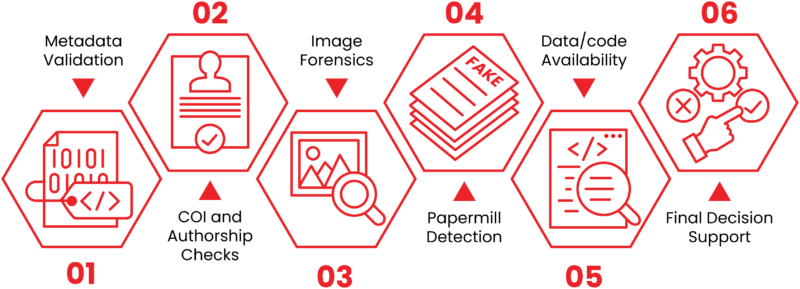
Phase 1: Integrity Risk Evaluation
Early Submission Screening
A light-touch, automation-forward screening layer that helps journals triage incoming manuscripts efficiently.
What it does
- Screens for integrity risk signals at submission
- Flags higher-risk manuscripts for targeted attention
- Creates a consistent, auditable baseline across editors and titles
Customer benefits
- Faster, more confident triage decisions
- Reduced editorial and reviewer workload
- Fewer downstream disruptions by catching issues early
Best used when: Submission volume is high and early prioritization is critical.
Phase 2: Research Integrity Quality Control
Pre-Acceptance Verification
A deeper, evidence-driven set of checks applied to manuscripts nearing acceptance—functioning as an integrity quality gate before publication.
What it covers
- Text integrity: similarity assessment, AI-related signals, and contextual review
- Image integrity: detection of duplication, manipulation, or reuse with figure-level documentation
- Data & policy compliance: verification of data availability, ethics statements, and transparency requirements
Customer benefits
- Prevents costly post-publication corrections or retractions
- Provides editors with clear evidence to support decisions
- Protects reviewers and readers from unreliable content
Best used when: Journals want strong assurance before accepting articles for publication.
Phase 3: Research Integrity Case Management
Post-Publication Support
Structured support for managing integrity concerns that arise after publication, including reader allegations and institutional inquiries.
What it provides
- Standardized intake, triage, and case tracking
- Documented timelines, evidence, and decision rationale
- Guidance aligned with publishing ethics best practices
- Support for communications and outcome recommendations
Customer benefits
- Reduced reputational and legal risk
- Clear, defensible handling of complex cases
- Less reactive “firefighting,” more controlled resolution
Best used when: Journals need consistency and confidence in post-publication decision-making.
Designed for Flexibility and Scale
- Modular deployment – Start with one phase and expand over time
- Workflow-aligned – Fits existing editorial processes and systems
- Editor-led decisions – KGL provides evidence and recommendations; editors retain authority
- Portfolio-ready – Scales from individual journals to large publisher programs
There is no all-or-nothing commitment—only what fits your needs today.
What Publishers Gain
Reduced Editorial Burden
Targeted screening and evidence packages allow editors and reviewers to focus on scientific merit—not forensic detection.
Lower Risk, Higher Defensibility
Consistent processes and documented findings support fair, transparent decisions.
Stronger Trust in the Scholarly Record
Early detection, pre-acceptance controls, and responsible post-publication management protect journal credibility over time.
Why KnowledgeWorks Global Ltd.?
KGL partners with publishers to make research integrity manageable, scalable, and defensible.
We don’t replace editorial judgment—we support it with:
- Proven workflows
- Evidence-first review
- Practical integration into real publishing operations
Integrity is not a single checkpoint. It’s a lifecycle responsibility—and KGL helps journals uphold it at scale.
Ready to strengthen research integrity across your publishing workflow? Connect with us to explore how our modular, end-to-end services can support your journals today—and scale with you tomorrow.
Latest Insights

AI agents are reshaping SaaS platforms by combining human oversight, trusted workflows, contextual intelligence, and measurable automation across publishing and education.

How Structured Content and Smart Submission Reduce Author Burden and Make Manuscripts Review-Ready Sooner.

Stop asking, “Was AI used?” Start asking, “Why should I trust this research?” The scholarly record needs visible accountability, not invisible assumptions of good faith.